
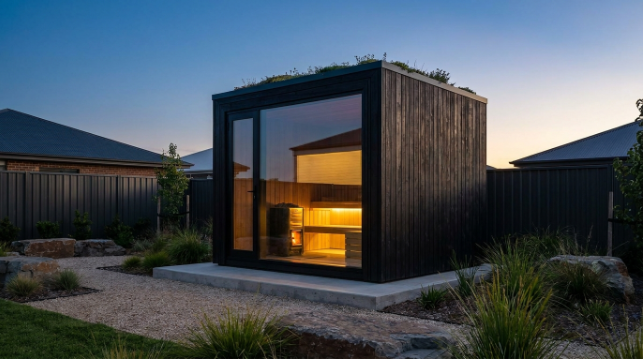
A cube sauna will not show up as a fixed dollar amount on a home appraisal the way a bathroom remodel might, but it changes how much of the year a backyard actually gets used. In neighborhoods where buyers already spend on wellness and outdoor living, a well-kept sauna can shorten time on market and support a slightly stronger comparable-sales case. In a starter-home price bracket, the same structure is more likely to be viewed as a bonus feature than a factor that changes the offer. Whether it adds measurable value in your specific market depends more on your neighborhood and climate than on the sauna itself.
What Exactly Is a Cube Sauna?
A cube sauna is a boxy, architectural outdoor sauna, usually with a flat or slightly pitched roof and a full glass front wall, built to sit on a deck, patio, or dedicated pad rather than dug into the ground or framed as an addition. It differs visually from a curved barrel sauna and from a converted shed or cabin build. The SaunaLife CL7G, for example, is built from premium thermo-spruce with knotless thermo-aspen benches, a full tempered glass front, and a hexagonal roof vent for airflow, with interior dimensions of roughly 87.5 inches wide by 70.8 inches deep by 85.5 inches tall. Buyers looking at cube saunas are generally comparing modern Scandinavian styling against the more rustic look of a barrel model, not comparing sauna types on function alone.
Does Adding a Sauna Increase Resale Value?
There is no standardized cost-versus-value study for outdoor saunas the way there is for kitchens or a new roof, so any specific resale percentage claim should be treated with suspicion. What real estate agents in cold-weather and wellness-forward markets consistently report is faster interest and stronger open-house turnout for homes with a working, well-maintained sauna already installed, compared with a comparable home without one. That is a demand signal, not a guaranteed appraisal bump. A sauna installed poorly, wired incorrectly, or left in visibly rough condition can work against a sale rather than for it, since it reads as a maintenance liability instead of an amenity.
What Do Appraisers Actually Count?
Appraisers work from comparable sales and permitted square footage first. An outdoor sauna on a deck or pad, without a permanent foundation, typically gets noted as a site amenity rather than priced as an addition. If the unit sits on a permanent foundation and was permitted as a fixed structure, it has a better chance of being reflected in the valuation, similar to a permitted pergola or outdoor kitchen. This is a case where paperwork matters almost as much as the build quality. Keeping the electrical permit, any building permit, and the original product documentation on file gives an appraiser and a future buyer’s inspector something concrete to work from.
How Much Should You Budget for a Quality Cube Sauna?
Pricing on cube saunas runs from around $4,000 for a compact two- or three-person unit to $8,000 or more for a large six-person model with a full glass front and premium wood. The SaunaLife CL7G, a six-person cube sauna with multi-level bench seating and over seven feet of interior headroom, lists at $7,990 before the heater. Most cube saunas ship without a heater included, and an 8-kilowatt or larger electric heater plus a dedicated 240-volt circuit typically adds $1,200 to $2,500 once wiring is included. Retailers that specialize in outdoor saunas, including SweatDecks, list model-specific pricing and interior dimensions on the product page, which is worth comparing directly against any listing that quotes a price without stating wood species or heater compatibility.
What Separates an Entry Model From a Premium One?
Wood species and drying process are the biggest quality signal. Thermo-treated spruce and cedar resist warping and release little resin once hot; a listing that just says “premium wood” without naming the species and drying method is worth questioning. Bench construction matters too, since contoured thermo-aspen benches with backrests hold up to repeated heat cycling better than flat, unfinished boards. Ventilation design is another marker: a proper roof vent system, like a hexagonal vent, keeps sessions breathable even with several bathers inside, where a sealed box without dedicated airflow gets stuffy fast. Shipping weight is a rough proxy for build density; a six-person cube sauna in the 2,000-pound range generally indicates thicker wall panels than a much lighter unit of the same footprint.
Where Should You Place a Cube Sauna for the Best Return?
Placement affects both usability and how the structure reads to a future buyer. A cube sauna set near an existing patio or deck, with a clear sightline from the house, gets used more often than one tucked in a far corner of the yard, and frequent use is what keeps the wood and hardware in good condition. Drainage matters as much as sightlines: standing water at the base accelerates wood breakdown regardless of species. Clearance from property lines and combustible structures is typically dictated by local code once an electric heater is involved, so confirming setback requirements before pouring a pad avoids having to relocate the unit later.
Does a Warranty Matter to a Future Buyer?
A transferable warranty is a small but real selling point, since it tells a buyer’s inspector that the wood and hardware were sourced from a maker willing to stand behind the build for years, not just through the return window. A limited lifetime warranty on the structure, paired with a separate multi-year warranty on the heater, is a reasonable baseline for a mid-range to premium cube sauna. Ask whether the warranty transfers with the home or stays tied to the original purchaser, since transfer terms vary by manufacturer and this detail rarely gets checked until it is too late to matter.
Assembly method also factors into long-term condition, which in turn affects how the structure shows years later. Units engineered for a single-day assembly with pre-cut panels tend to have tighter, more consistent joinery than a fully custom on-site build, simply because factory-cut panels are less prone to gaps from field measurement error. Tighter joinery holds heat better and keeps moisture out of seams, both of which slow the kind of visible wear that makes a structure look dated to a buyer walking through years later.
Frequently Asked Questions
Will a cube sauna show up on a home appraisal? Rarely as a specific dollar line item. Most appraisers treat it as a site improvement noted in the report, similar to a fire pit or pergola, rather than a priced addition.
Is a cube sauna a good investment if I plan to sell in a few years? It depends more on your local buyer pool than the sauna itself. Cold-climate and wellness-forward markets respond better than budget-constrained starter-home markets.
Do I need a permit to install a cube sauna? Most areas require an electrical permit for the dedicated circuit, and some require a building permit for a permanent foundation. Check with your local building department first.
How is a cube sauna different from a barrel sauna for resale purposes? Style and aesthetic fit, mainly. Neither outperforms the other in any documented resale data.
How long does a quality cube sauna last? Fifteen to twenty five years for the wood structure with basic upkeep. Heater elements usually need replacement sooner, within five to ten years of regular use.
References
- Cardiovascular and Other Health Benefits of Sauna Bathing: A Review of the Evidence, Mayo Clinic Proceedings, 2018
- Clinical Effects of Regular Dry Sauna Bathing: A Systematic Review, Evidence-Based Complementary and Alternative Medicine, 2018
- Benefits and risks of sauna bathing, The American Journal of Medicine, 2001
- Saunas and your health, Harvard Health Publishing
By Megan Carpenter